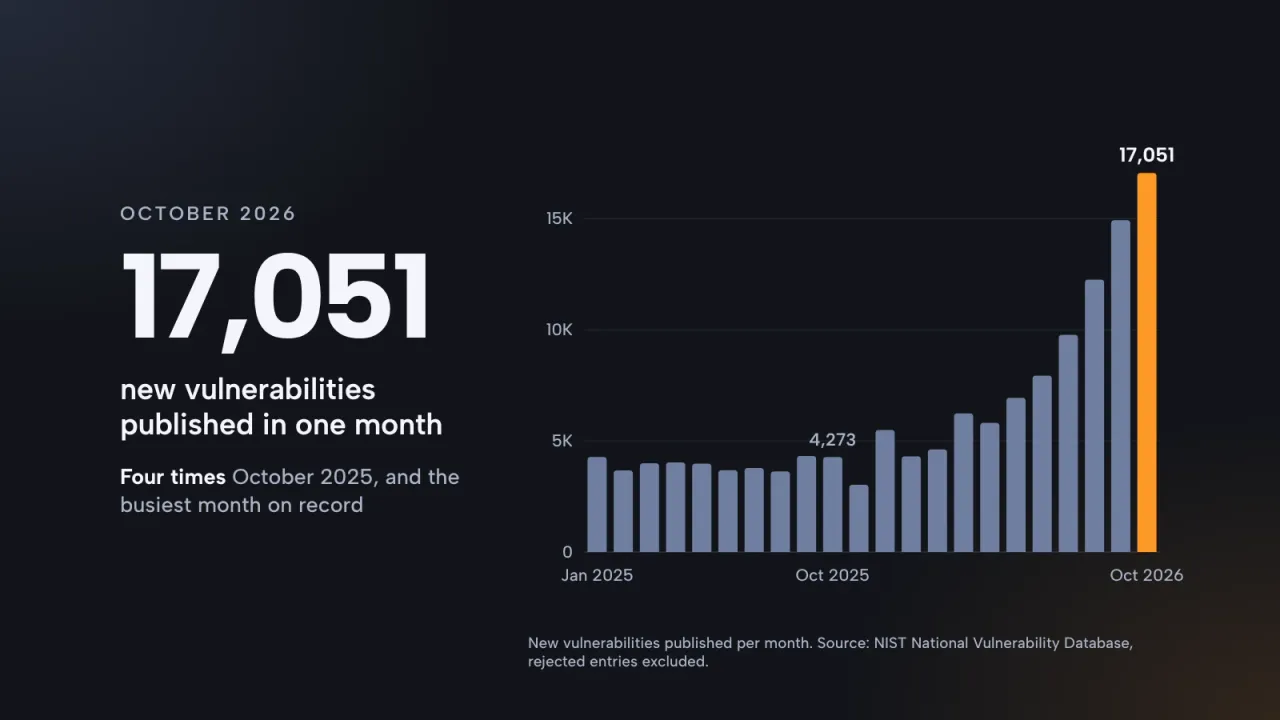
Believe it or not, 17,051 new software vulnerabilities were published in October 2026. That is 550 every single day! It was the busiest month on record, four times what we saw in October 2025, and just over 4% of every vulnerability ever catalogued landed in that one month. Yes, you read that right, 4% in a single month!
Those numbers come straight from the US government’s National Vulnerability Database, and 2026 as a whole is running at more than double last year. A lot of people are putting the jump down to AI being used to hunt for bugs, along with changes in how flaws get counted. To be honest, the reason matters less than the result. The list of things that could be wrong with your systems is growing far quicker than any IT team can keep up with.
In this article we are going to look at what that means for your business, why vulnerability scanning is the only sensible way to stay on top of it, and how we run scanning and patching together as a managed service so you don’t have to.
So what is the problem?
Let’s start with the obvious question. If you are already patching, why should you care?
The honest answer is that patching only covers what your patching tool knows about. If a device was never enrolled it never gets patched, and nobody notices because the report still says everything is up to date. On top of that, plenty of kit isn’t covered by a normal patching tool at all. Think firewalls, switches, the management cards built into your servers, that Linux box somebody set up years ago, or the application that went out of support and got left running.
When we scan a network, those are the things that tend to come back with the serious findings. Quite often it isn’t the laptops at all!
What does a vulnerability scan actually do?
A vulnerability scanner checks every device on your network (servers, laptops, firewalls, switches, printers and anything you have in the cloud) against the list of known flaws, then tells you what it found. Missing updates, software that has gone out of support, risky settings, how serious each one is and what the fix is.
There are two types worth running. An external scan shows what anybody on the internet can see of you. An internal scan shows what an attacker could get to once they are inside, and this is normally where most of the findings turn up. Where we can, we let the scanner log in to each machine, because it sees far more that way than it does looking from the outside.
Is a yearly pen test not enough?
In short, no. A penetration test is brilliant. It is a skilled person trying to break in, but it is a snapshot of one week of the year. With almost 4,000 new vulnerabilities being published every week, a snapshot goes out of date very quickly.
Scanning is automated, so it can run every week without anybody lifting a finger. It also matters if you hold Cyber Essentials, which expects security updates to be applied within 14 days of release, and Cyber Essentials Plus includes vulnerability scans as part of the audit. You simply cannot prove a 14-day standard with a once-a-year check.
A real example from last month
On 21 October the PHP project released fixes for two critical flaws, nicknamed PHP2Shell, which can let an attacker run code on a web server without even logging in. Within days researchers were reporting successful attacks.
PHP sits behind a huge number of websites and business applications, so that morning every IT team had the same two questions. Where do we run PHP, and which version is it? If you had a scan from the week before, you had the answer in minutes. If you didn’t, you were in for days of asking around, and those are the days that matter!
How Next2IT does this as a service
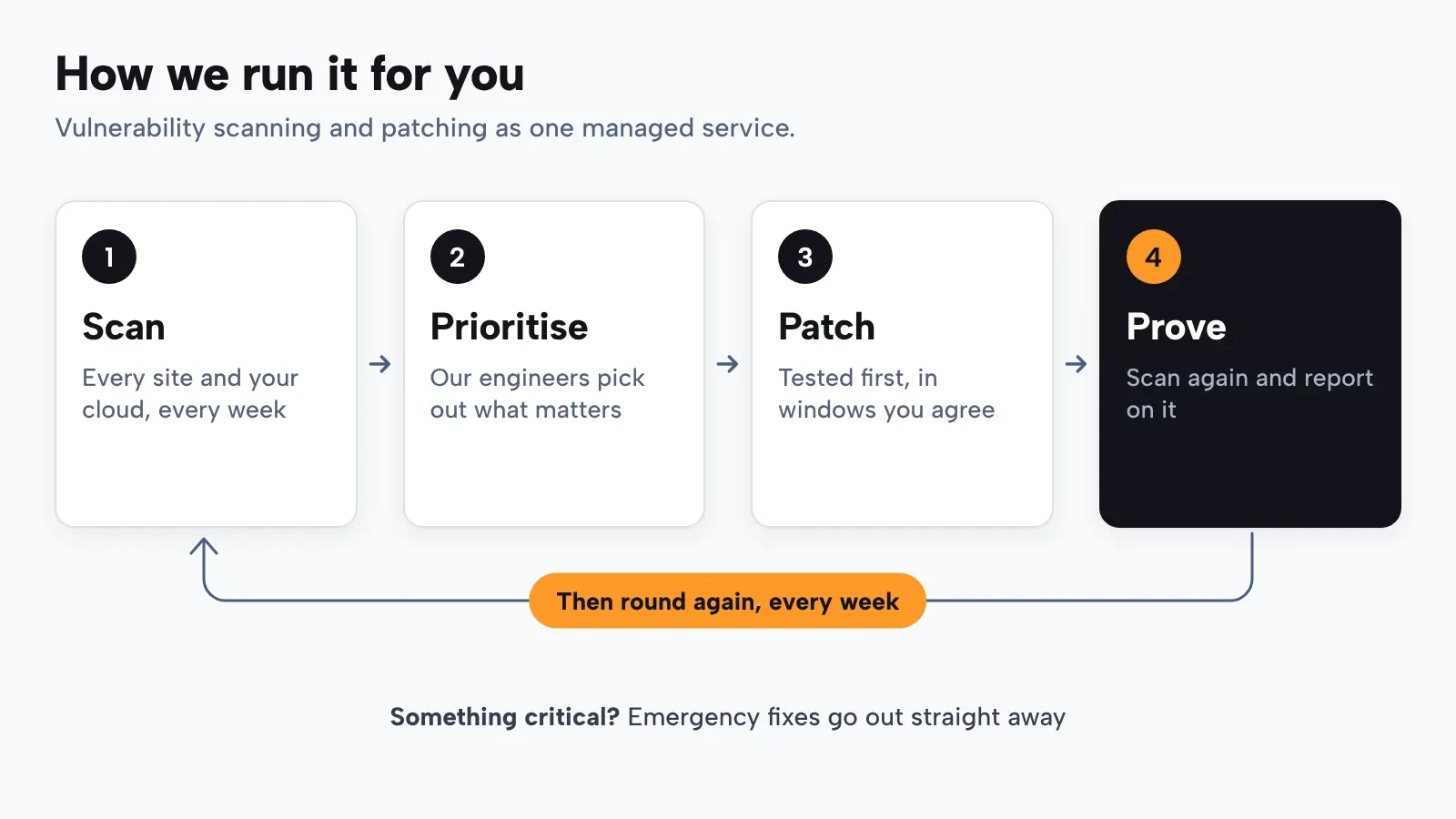
This is where we come in. Finding vulnerabilities is only half the job because somebody still has to fix them, and that is why we run vulnerability scanning and patching together as one managed service. This is how it works:
- We scan. We set up scanning across your sites and your cloud and run it on a schedule, normally weekly, so there is always an up-to-date picture of what is actually out there.
- We prioritise. Our engineers go through the results so you don’t get handed a report the size of a phone book. Anything facing the internet, anything on the US cyber agency’s list of vulnerabilities being used in real attacks, and anything on a system your business depends on goes to the top.
- We patch. Windows, Linux, macOS, third-party applications, hypervisors and the firmware on your firewalls and switches. Updates go to a small test group first, then roll out in waves during maintenance windows you have agreed, so a bad patch gets caught early.
- We move fast when it counts. When something critical lands, like PHP2Shell, we don’t wait for the next window. Emergency fixes go out straight away with the same testing, just quicker.
- We prove it. The next scan confirms the fix has actually worked, and you get reporting that shows what is fixed, what is pending and what has been deliberately deferred. That is the evidence Cyber Essentials, ISO 27001 and your insurers ask for.
And the awkward stuff? Every network has something that can’t be patched, like the machine running a piece of kit on an old version of Windows. We don’t pretend it isn’t there. We isolate it, lock it down and tell you about it plainly.
All of this is run by our UK operations centre, the same team behind our 24×7 IT support, so when the next big one drops in the middle of the night somebody is already on it.
In conclusion
Vulnerabilities are being found faster than ever before, and that is not going to slow down. The good news is that you don’t need a bigger IT team to deal with it. You need to know what is on your network, fix what matters first and be able to prove you have done it.
If you would like to see what a scan of your network turns up, or you want to hand the whole lot over to us, get in touch and our team will be more than happy to help! You can read more about our patch management service, and if you fancy a quick look at one corner of your exposure today, try our free outbound firewall test.
Figures: NIST National Vulnerability Database, vulnerabilities published per month excluding rejected entries, counted on 17 November 2026.